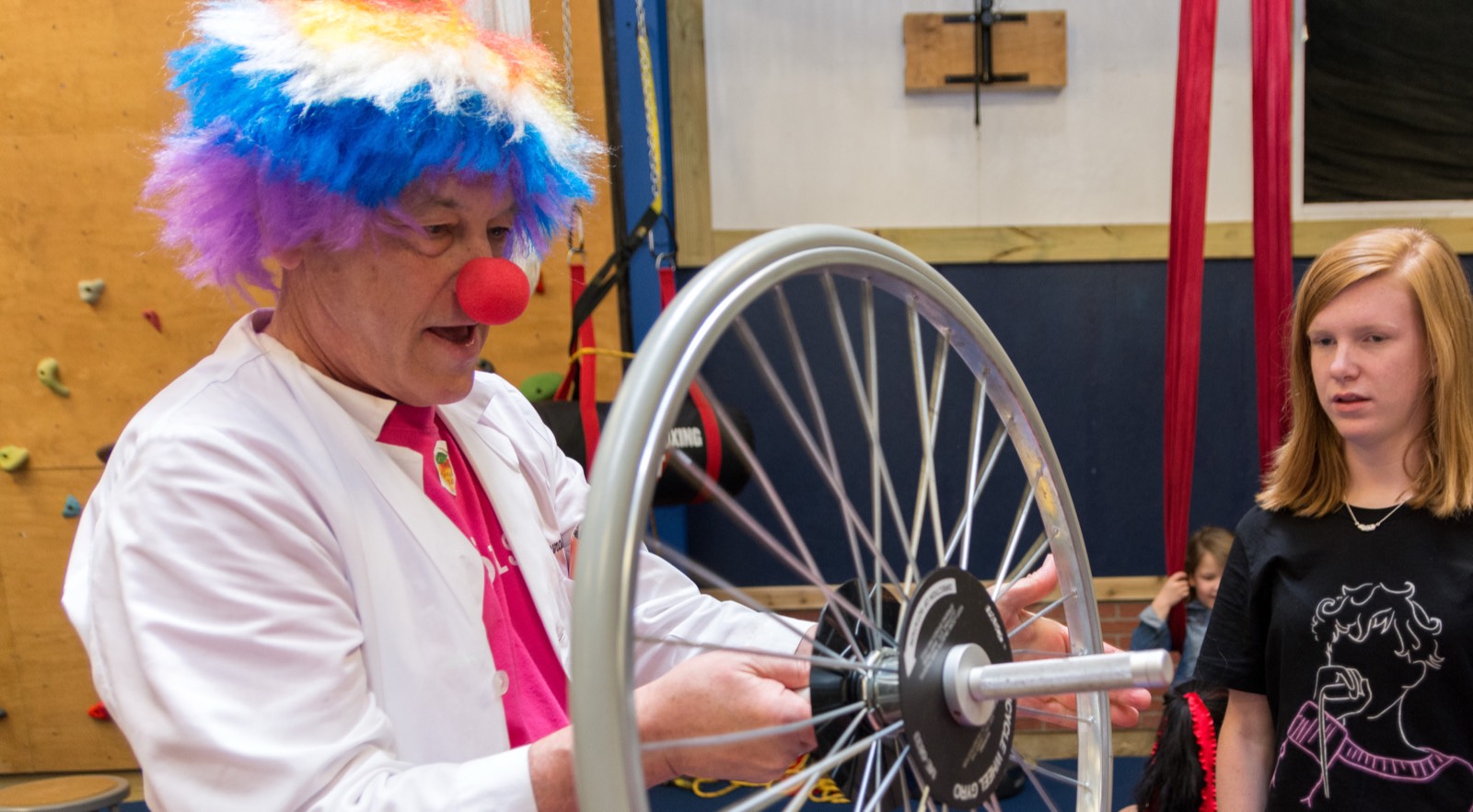
Math should be fun! For the last decade or so I have been working to bring the fun side of math to audiences in Atlanta and around the country including through dance, magic, music, and the circus, and on at least one occasion through me wearing a wig and a red nose.
Each year Science ATL gives the David B. Hartnett Award for Public Engagement with Science to an Atlanta scientist or engineer who has done the most to make this a science city. In 2025 it came to me, which was both lovely and a little suspicious, given how much of the work involved a wig.
The citation notes that I was the first person Science ATL reached at Georgia Tech when the Atlanta Science Festival was still only an idea, and that I brought the university on board as a founding partner. Everything since — the circus, the choreographers, the orchestra — has been an attempt to justify their optimism.
Evans has made science and math entertaining and engaging for thousands of people in Atlanta. Science ATL, 2025 award citation
It started as a loose collective of artists and mathematicians running experiments on each other's crafts, which is a polite way of saying we were not sure it would work. In 2018 it became a real thing: a Georgia educational nonprofit and 501(c)(3), incorporated by Xander Flood, Kristel Rose Tedesco, and me.
The premise is simple enough. Mathematics has structure, rhythm, symmetry, and surprise, and so do dance, music, and circus arts. Put practitioners of each in a room and something happens that neither a lecture nor a recital could manage on its own.
Choreography built on the mathematics and history of ideas like graph theory — not illustrating it, but moving through it.
Original scores, and older ones read closely: Bach's crab canon, for instance, is a palindrome long before it is a piece of music.
Juggling, aerial work, and balance are applied mechanics performed by people who are extremely good at it. The physics is already in the act.
Movement games that teach mathematics, developed and taught in schools — and the Kristel Rose Tedesco Residency, which commissions new mathematical works.
Kristel Rose Tedesco, our co-founder and choreographer, died in early 2020. The residency carries her name, and a good deal of what the company does still carries her thinking.
A decade of finding out what mathematics looks like when it is performed rather than explained.
The first collaboration at the Atlanta Science Festival, made with Nicolette Emanuelle. Angular momentum, center of mass, and a great deal of nerve.
The production that named the company — three Festival shows, in fact. Choreography by our founding partner Kristel Rose Tedesco, working with a mathematical team of Xander Flood, Andy Imm, and me, on dances drawn from the mathematics and history of graph theory and transformations of functions.
A full curriculum of movement games for teaching mathematics, developed and taught by Tedesco, ending in an assembly for several hundred students.
Our most ambitious piece: the Georgia Tech Symphony Orchestra, an original score by Marshall Coats, choreography by Tedesco, and a narrative I wrote about Euler's 1736 walk around a Prussian city — the walk that started graph theory. Funded by Science in Vivo, and it popped up around campus and the city that autumn.
The annual one. See below — it has outgrown this list.
Not a Mathematics in Motion production, this one — the Georgia Tech Math Team taking mathematics onto the streets of Atlanta unannounced. Exactly as much fun as it sounds, and we are always looking for partners in crime.
The namesake show brought back with new choreography and circus performances.
Our annual event at the Atlanta Science Festival, and the one that reaches the most people. It has run since 2019, including a determinedly cheerful online edition in 2021.
The 2025 edition, Mathapalooza at the Gallery, opened The Art of Math at the Sun ATL gallery on Edgewood Avenue: a mathematical magic show by Matt Baker, a performance of Bach's crab canon by Tracy Woodard with a discussion of the symmetries hiding inside it, circus arts, puzzles, games, and a room full of people making mathematical artwork of their own. Presented with VinsonArt.
Part of the Atlanta Science Festival, which now draws tens of thousands of people across the city every March.
Moved online rather than cancelled, on the theory that a pandemic is no excuse for bad puzzles.
Martin Gardner spent twenty-five years writing the Mathematical Games column in Scientific American and, in doing so, recruited a sizeable fraction of my generation into mathematics without any of us noticing at the time. Gathering 4 Gardner exists to keep that going, and I sit on its board.
Its stated aim is to stimulate curiosity and the playful exchange of ideas across recreational mathematics, magic, science, literature, and puzzles — a list that is really one thing wearing five hats.
A biennial conference of mathematicians, magicians, puzzlers, and people who are hard to classify. G4G17 is set for February 2028 in San Francisco.
Held on the 21st of the month, open to anyone, and also hosted locally by whoever fancies it — including, in 2020, a Math Court skit performed by Georgia Tech's Club Math.
Most of these projects began with somebody saying “this would never work” and then trying it anyway. If you make things — choreography, music, circus, puzzles, paint — and want to make one out of mathematics, I would like to hear about it.
Get in touch →