The professional side

Mathematics

Spectral theory, semiclassical quantum mechanics, and the long argument between geometry and the eigenvalues of a differential operator.

Research

What I work on

My work concerns the Schrödinger equation and related differential operators — elliptic operators, mostly, on domains, manifolds, and graphs. The recurring question is what the spectrum reveals about the underlying geometry, and how sharply that relationship can be pinned down. Below are the four threads that most of my papers belong to.

or, the way a spectral theorist reads it, Ĥψ = Eψ — an eigenvalue problem
The time-independent Schrödinger equation. It asks which energies E a system is permitted to have, and nearly everything on this page follows from taking that question seriously for fifty years and declining to let go of it.
A particle in a single well V(x) E₁ E₂ E₃ E₄
Confine a particle and its energies become discrete: only certain levels are allowed, and the wavefunction picks up one more oscillation at each. How large the first gap E2E1 must be, for a well of a given shape, is the subject of a good deal of my recent work.
An eigenfunction that localizes
A quantum graph — a network with a differential operator living along its edges. Eigenfunctions need not spread out evenly across one: some concentrate on a subgraph and are exponentially small everywhere else. Working out when that happens, and how fast the decay is, is what the Agmon-metric papers are about.
01

Schrödinger operators

Semiclassical quantum mechanics and the behavior of operators with singular or strongly localized potentials — the subject of my dissertation and a preoccupation ever since.

02

Spectral geometry

Eigenvalue estimates, sum rules, trace identities, and universal bounds: how much of a domain's geometry is legible in its spectrum, and how sharp the resulting inequalities can be made.

03

Quantum & combinatorial graphs

Spectral theory on metric and discrete graphs — localization of eigenfunctions, Agmon metrics, gaps between consecutive eigenvalues, and what eigenvalue distributions say about graph structure.

04

Shape optimization

Which shapes make a given eigenvalue as large or as small as it can be — geometric optimization problems for differential operators, including questions arising in nanophysics.

Can one hear the shape of a drum?

Mark Kac put the question in print in 1966. If you knew every frequency at which a drumhead could vibrate, would you know what shape it was? The answer, settled in 1992, turned out to be no — one can build differently shaped drums that sound exactly alike. But it is very nearly yes, and the business of my field is working out how nearly.

no nodes
one nodal line
two nodal lines
a nodal circle
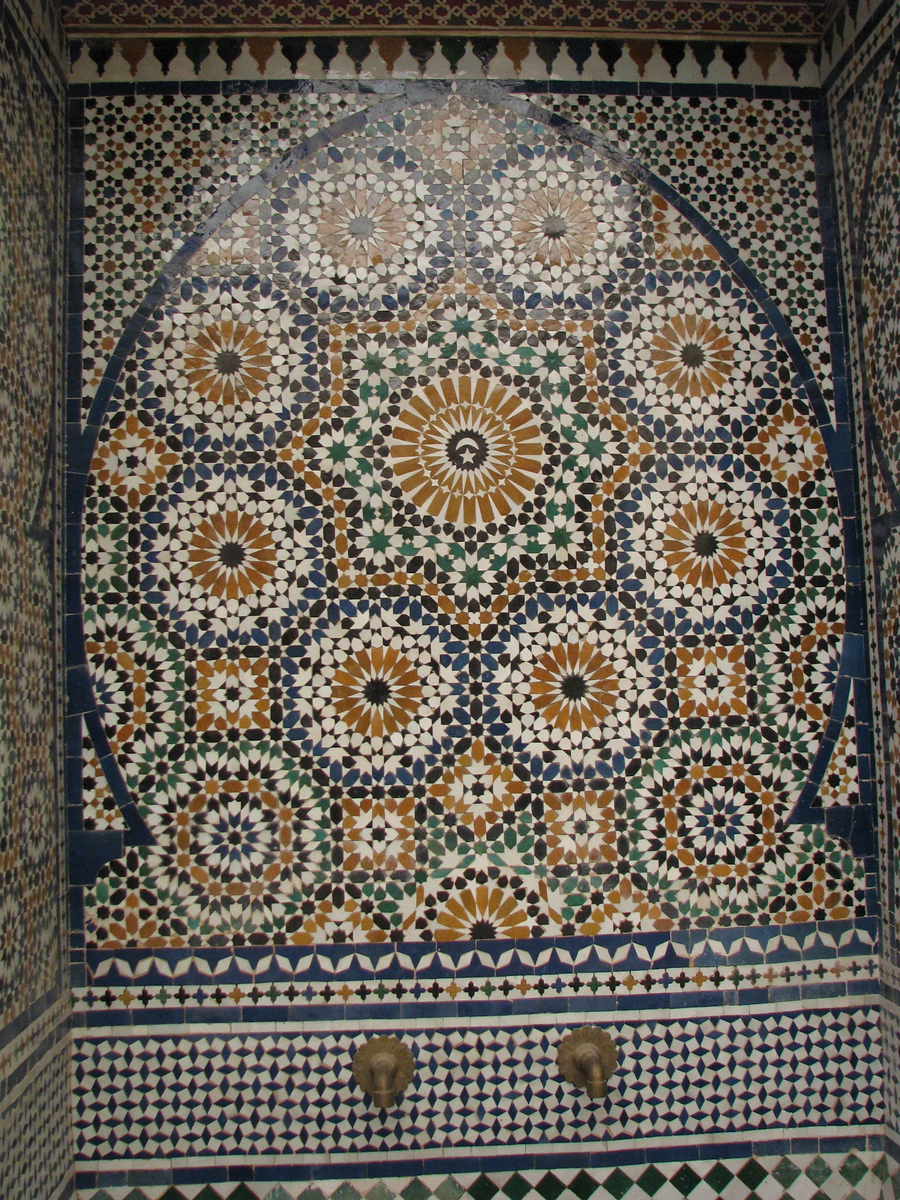
An arched fountain niche covered in intricate Moroccan zellij tilework of interlocking stars and rosettes
Zellij tilework, Marrakech, 2008
An aside

Symmetry, found in the wild

I photographed this fountain in Marrakech on a trip in 2008. The craftsmen who cut its tiles were working several centuries before anyone wrote down the classification of plane symmetry groups, and they did not need it: the constraints of the material and the discipline of the pattern got them there on their own.

I keep the picture around because it is a useful reminder of what the subject is actually about. The mathematics is not the notation. It is the structure that was already there.

Books & online texts

Written down

Linear Methods of Applied Mathematics

Orthogonal series, boundary-value problems, and integral operators, written with James V. Herod (1994, revised 2000). It has been free on the web since long before that was fashionable, and is still used in courses at Georgia Tech.

Read it online →

Thirring, A Course in Mathematical Physics 1

My translation of Walter Thirring's classic first volume, Classical Dynamical Systems, published by Springer in 2012.

Notes & shorter texts

Classnotes on dynamical systems, and a short history of operator theory — both kept at mathphysics.com, the repository I have used for teaching material since the 1990s.

Dynamical systems →
A short history of operator theory →

Recent papers

A complete list is best found on Google Scholar or in the arXiv.

Lectures & seminars

A selection, with slides

These are the talks I still get asked for. The slides are PDFs; a few of the accompanying videos have not survived the platforms that hosted them.

Appointments

Where the work happened

1976

Ph.D., Princeton University

Schrödinger Operators with Singular Perturbation Potentials, under Barry Simon. Undergraduate work at Stanford.

Late 1970s

Haverford · Vienna · MIT

Postdoctoral and teaching positions in the United States and Europe.

Before 1983

Johns Hopkins University

Tenure-track appointment in mathematics.

1983 —

Georgia Institute of Technology

School of Mathematics. Managed the School's graduate programs before moving to the College of Sciences.

2005 – 2014

Associate Dean for Research

College of Sciences, Georgia Tech.

Now

Professor & Associate Dean Emeritus

The same work, with fewer meetings.

Honors

Recognition

  • Fellow, American Association for the Advancement of Science
  • Sloan Research Fellowship, 1983
  • Eichholz Faculty Teaching Award, Georgia Tech, 2006
  • Outstanding Service Award, Georgia Tech, 1996

Visiting positions

Repeated visits to France and Austria over four decades:

  • Toulouse — the CNRS laboratory M.I.P.; the IRSAMC at Université Paul Sabatier; CEREMATH at Toulouse 1
  • Vienna — the Erwin Schrödinger Institut, and the Institut für theoretische Physik at the University of Vienna
  • Marseille (Luminy) — the Centre de Physique Théorique

Students

Eight doctoral dissertations and two master's theses supervised; papers written with more than thirty-five coauthors.

Abroad & in service

  • Lectures, workshops, and teaching programs in Benin, Senegal, Mali, and Tunisia — including the CIMPA school at Kairouan and the African Institute for Mathematical Sciences
  • Long involvement with the International Association for Mathematical Physics and its News Bulletin
Teaching

Courses

Over four decades at Georgia Tech, mostly in analysis and its applications — from first-year calculus to graduate operator theory. A selection:

2411 · Honors Vector Calculus 2401 · Vector Calculus 1502 · Calculus II 1512 · Honors Calculus II 4347 · Introduction to PDE 4348 · PDE II 6021 · Topology of Euclidean Spaces 6321 · Complex Analysis 6341 · Graduate PDE I 6342 · Graduate PDE II 6580 · Hilbert Space 6701 · Mathematical Methods of Applied Science 7334 · Operator Theory
The “math is fun” side

Getting it out of the building

Everything above is the formal half. The other half involves a dance company, a symphony orchestra, a circus, and — on at least one documented occasion — a rainbow wig and a red nose. For twenty years I have been putting mathematics in front of people who did not come to a lecture hall to find it, and in 2025 Science ATL gave me the David B. Hartnett Award for Public Engagement with Science for the trouble.

Mathematics in Motion

The nonprofit production company I co-founded in 2018, making performances out of mathematics with dancers, musicians, and circus artists.

The Seven Bridges of Königsberg

A symphony orchestra, an original score, a choreographer, and Euler's 1736 walk around a Prussian city — the walk that started graph theory.

Mathapalooza!

Our annual event at the Atlanta Science Festival: magic, music, circus arts, puzzles, and a room full of people making mathematical art.

Gathering 4 Gardner

Board member of the foundation that keeps Martin Gardner's recreational mathematics going, and of its Celebration of Mind.
And the rest of it

There is a life outside the seminar room

Mountains, medinas, marine iguanas, and the people I have seen them with.

Life & travels →